MATH748R
Selected Topics in Geometry and Topology:
Noncommutative Geometry and Topology
Fall 2007
Course web site:
http://www.math.umd.edu/~jmr/748R/
Meeting times:
MWF, 10:00am-10:50am (MTH 0102).
Important note: The course will not meet on
Wednesday and Friday, September 5th or 7th, since I will be at an
international conference on Noncommutative Geometry, nor on
the Fridays of September 14th and 28th and October 5th, because
of the Jewish religious holidays. If paticipants are interested,
I will arrange makeup times.
Instructor:
Professor
Jonathan
Rosenberg. His office is room 2114 of the Math Building,
phone extension 55166, or you can contact him by
email.
Office hours are Mondays and Wednesdays after class,
or by appointment.
Texts:
The foundation of this subject is the remarkable book Noncommutative
Geometry by Alain Connes,
Academic Press, 1994, ISBN 0-12-185860-X. From UMCP computers you can
view the MathSciNet featured review by John Roe
here.
More detailed reviews from the AMS Notices are
this one by
Vaughan Jones and Henri Moscovici and
this one by
Andrew Lesniewski. Connes has now made the whole book available
free on-line at
his web page,
along with a draft of a book in progress by Connes and Marcolli,
and the text of many of his papers, including the key Comptes Rendus
note called "C* algebras and differential geometry" (available in
both the French original and a new English translation). Other
useful books are Joseph Varilly, An introduction to
noncommutative geometry, EMS Series of Lectures in Mathematics,
European Mathematical Society (EMS), Zürich, 2006;
Matilde Marcolli, Arithmetic noncommutative geometry,
University Lecture Series, 36, American Mathematical Society,
Providence, RI, 2005; and Nigel Higson and John Roe, editors,
Surveys in Noncommutative Geometry, Clay Math. Inst./American
Math. Soc. publications, vol. 6, American Mathematical Society,
Providence, RI, 2006.
I have two sets of lecture notes on line which may be helpful:
Applications of Non-Commutative
Geometry to Topology and Applications
of noncommutative topology in geometry and string theory.
Prerequisites:
To learn this subject thoroughly you need a background in both
geometry/topology and in functional analysis, but for purposes of this
course, the equivalents of MATH 730 and of MATH 630 should suffice if you
are willing to take some things on faith. We will develop
from scratch most of the operator theory we need.
Course Requirements:
There will probably be a few homework assignments,
but there will be no exams. At some point participants may be asked to
present some material to the rest of the class.
What is noncommutative geometry?
A basic notion in mathematics, going all the way back to Descartes, is
that we study a space by means of functions on the space. In fact,
the algebra of functions "determines" the space.
Examples of this principle:
- Algebraic Geometry: R a commutative ring, Spec R a scheme.
- Gelfand-Naimark correspondence: X
a locally compact Hausdorff space, C0(X)
a commutative C*-algebra (a Banach algebra that can be realized
as a norm-closed *-algebra of bounded operators on a Hilbert space).
Quantum mechanics, however, suggests that some physical systems should
be modeled by ``spaces'' on which ``functions'' are not commutative.
C*-algebras are natural models for the function algebras, since they have
a good structure theory and since quantum mechanics demands that observables
be self-adjoint operators on some Hilbert space.
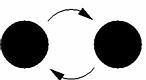
Example: a spinning electron, with two [pure] states: "up"
and "down."
- Semiclassical model: space S0
of two points, possibilities of transitions between them.
- Quantum model: space with "functions"
M2(C). Generators
are matrix units eij with relations
eijekl=eil
when j=k.
Second Example from Representation Theory:
Take G to be a finite group. The noncommutative
space G^ has "algebra of functions"
the group ring CG.
Fields Medalist Alain
Connes has pursued the idea of noncommutative spaces
to a much greater extent, and has
developed both "topology" and "differential geometry" on such
noncommutative spaces. We will go over the foundations of his theory
and then develop a number of very interesting applications to ordinary
geometry and topology. There are also many applications to
mathematical physics, though we probably won't have time to do much
more than mention these in passing. Recently, noncommutative geometry
has begun to play a big role in number theory as well, and we will try
to explain a bit of this connection.