Solving the Laplace Equation (Dirichlet case) using the Discrete Sine Transform
Contents
You first have to download m-files
Download the m-files sintr.m , isintr.m and put them in the same directory as your other m-files.
Solve the Laplace equation  in a rectangle
We want to find a function  for
 ,
 such that

We prescribe Dirichlet boundary conditions on all four sides of the rectangle:


At the bottom, left, and right side of the rectangle we want  . At the top side of the rectangle we want
 with a given function
 for
 .
The method of Separation of Variables gives the following Solution Formula:
First find the sine series  . Let
 and
 for
 . Then the solution is given by

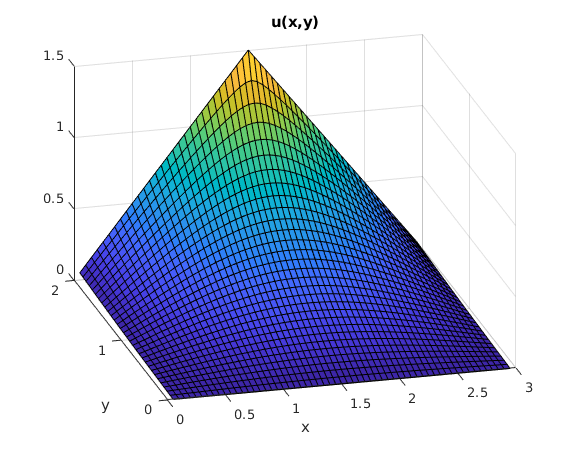
Example: For a rectangle with lengths  and
 use the given values
 at the top side of the rectangle.
A=3; B=2;                      % lengths of rectangle sides
fct = @(x) 1.5-abs(x-1.5);     % given function for top side of rectangle y=B
N = 60;                        % use spacing A/N for x
x = A*(1:N-1)'/N;              % only interior nodes            (column vector)
g = fct(x);                    % evaluate g for 1/N,...,(N-1)/N (column vector)

b = sintr(g);                  % take Discrete Sine Transform
kv = (1:N-1)';                 % column vector of k-values
muv = kv*pi/A;                 % column vector of mu-values
C = b./sinh(muv*B);            % coefficients C_k from solution formula

M = 30;
y = B*(0:M)/M;                 % find solution for these y-values (row vector)

W = sinh(muv*y);               % array of sinh(mu_k*y) for k=1...N-1, for all y-values
                               % (column vector)*(row vector) gives array
U = isintr(diag(C)*W);         % multiply 1st row by C(1), 2nd row by C(2), ...
                               % then take Inverse Sine Transform of each column

surf(x,y,U');                  % make surface plot of solution
xlabel('x'); ylabel('y'); title('u(x,y)')
view(-15,30);