Collective Dynamics and the Emergence of Patterns
MATH 858J, Fall 2026
Course Information
Place
MATH 1308 (unless otherwise stated)
Time
Tuesdays & Thursdays, 14-15:15pm
Instructor Professor Eitan Tadmor
Contact tel.: x5-0648 Email:
eitan Tadmor
Office Hours
By appointment 4141 CSIC Bldg #406
Grading homework assignments (40%); oral exam based on a final project (60%)
Prerequisite A graduate level one semester course
Course description
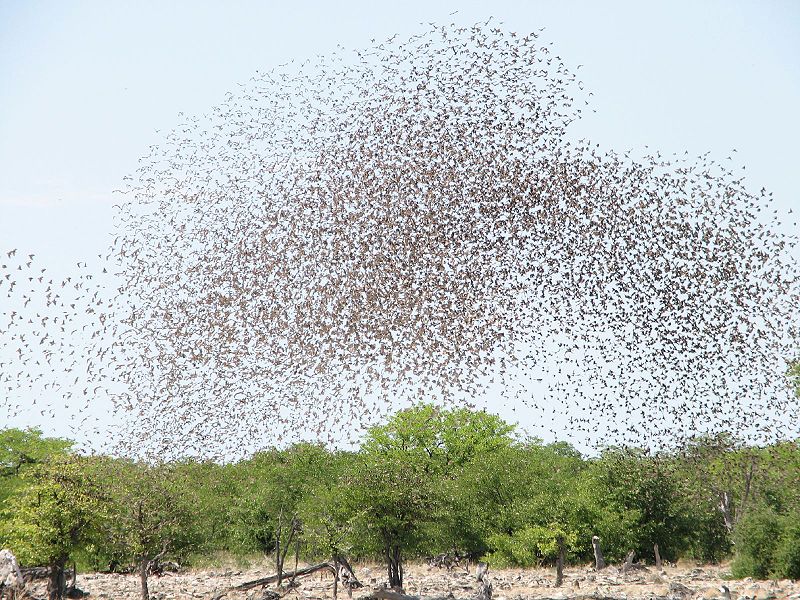
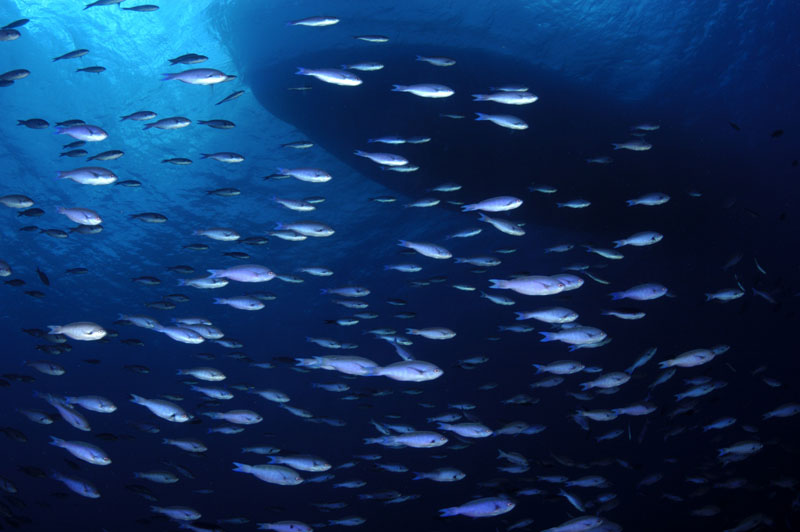
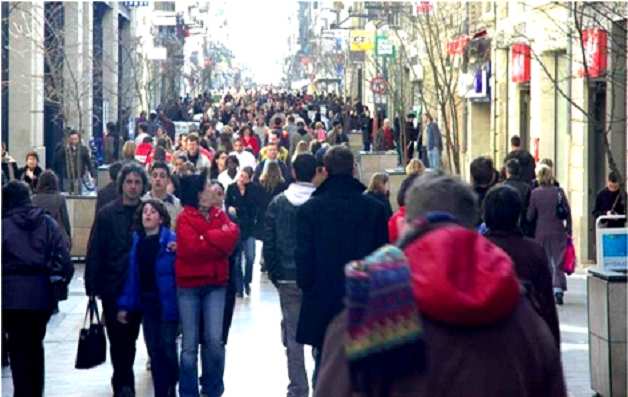
We will survey recent mathematical developments in collective dynamics of interacting agents. A main question of practical interest is how fundamental protocols of interaction — attraction, alignment, and repulsion — facilitate the emergence of high-order patterns in non-equilibrium systems.
Different models based on such protocols go back to the influential works of Kuramoto, Reynolds, Vicsek and Cucker & Smale. We will discuss their broad range of applications, from synchronization and opinion dynamics to swarming, robotics and the dynamics of transformers in LLM.
Three levels of descriptions will be considered: microscopic description of agent-based dynamics on graphs, mesoscopic mean-field description, and large-crowd hydrodynamic description.
.
Syllabus
1 Agent-based models: slides [ 10 examples ]
1.1 First-order models for aggregation . . . . . . . . . . . . . . . . . . . .
• Emergence of consensus . . . . . . . . . . . . . . . . . . . . . . . .
R. Hegselmann & U. Krause, The bounded confidence model (2002) (2019)
J. Lorenz A survey (2007)
V. Blondel, J. Hendricks & J. Tsitsiklis, On Krause’s multi-agent consensus (2009)
C. Brugna & G. Toscani,
Opinions and convictions (2015)
• Bearing only model . . . . . . . . . . . . . . . . . . .
L. Bellaiche1 & A. Bruckstein, Limited visibility (2017)
• Elo rating . . . . . . . . . . . . . . . . . . . . . . . .
P.-E. Jabin and S. Junca, Continuous model (2015)
• Clustering . . . . . . . . . . . . . . . . . . . . . . . .
K. Fukunaga & L. Hostetler,
Pattern recognition (1975)
D. Comaniciu & P. Meer, Consensus-based mean-shift (2002)
E. Arias-Castro, D. Mason & B. Pelletier
Estimation of the Gradient Lines (2016)
• Transformers and the geometry of emerging clusters . . . . . . . . . . . . . . . .
B. Geshkovski et. al. Mathematical Perspective (2025)
P. Rigollet, Mean-field dynamics (2026)
1.2 Second-order models for alignment
1.2.1 Flocking and Swarming . . . . . . . . . . . .
• Cucker-Smale (CS) model: F. Cucker & S. Smale, Emergent behavior
(2007a)
(2007b)
Extensions:
• Motch-Tadmor (MT) model:
S. Motsch & E. Tadmor, New model (2010)
A. Kotil, CS and MT probablistic method (2022)
Y.-J. Gao & J.-G. Dong, CS with cone of vision (2026)
• p-alignment
S.-Y Ha, T. Ha & J-H. Kim, CS with p-alignment, (2010) (p>1)
J. A. Carrillo, Y.-P. Choi & M Hauray,
CS with p-alignment (2014) Sec 4. (p<1)
E. Tadmor, p-alignment with pressure (2022) Sec. 5.3 (p>1)
• PTWA model: P. Degond & S. Motsch, Swarming agents
using curvature (2011)
1.2.2 Communication kernels . . . . . . . . . . . . . . . . . . . . . . . . . . . . . . . . . . . .
• Metric vs. topological
• Matrix communication
• Short- vs. long-range tails
• Regular vs. singular head
1.3 3Zone model: Attraction • Repulsion • Alignment . . . . . . . . . . . . . . . . . . .
Anticipation . . . . . . . . . . . . . . . . . . . . . . . . . . . . . . . . . . . . . . . . . . . . .
1.4 Extensions • External forcing • Rayleigh-type friction • Time delay . . . . . . .
• Vicsek model . . . . . . . . . . . . . . . . . . . . . . . . . . .
1.5 Synchronization • Kuramoto and related models . . . . . . . . . . . . . . . . . . . .
Lecture notes [ Part I. Agent-based models ]
2 Large-time emerging behavior
2.1 First-order models • Consensus . . . . . . . . . . . . . . . . . . . . . . . . . . . . . . .
2.2 Second-order models • Flocking . . . . . . . . . . . . . . . . . . . . . . . . . . . . . . .
ℓ∞ -diameter -- coefficient of ergodicity . . . . . . . . . . . . . . . . . . . . . . . . . . .
Lecture notes [ Part II.1 Coefficient of ergodicity ]
ℓ2 -diameter -- graph connectivity • spectral gap . . . . . . . . . . . . . . . . . . . .
Short-range kernels: propagation of connectivity . . . . . . . . . . . . . . . . . . .
Homophilious vs. heterophilious dynamics. . . . . . . . . . . . . . . . . . . . . . . .
3 Large-crowd behavior -- hydrodynamic description
3.1 Mean-field limit -- First-order aggregation models . . . . . . . . . . . . . . . . . . .
3.2 Mean-field limit -- second-order models . . . . . . . . . . . . . . . . . .
4 Large-crowd behavior -- hydrodynamic description
4.1 The closure of entropic pressure
4.2 Regularity and critical thresholds . . . . . . . . . . . . . . . . . . . . . . . . . . . . . .
4.3 Large-time emerging behavior . . . . . . . . . . . . . . . . . . . . . . . . . . . . . . . . .
Spectral gap • Energy Flctuations • Entropy . . . . . . . . . . . . . . . . . . . . . .
4.4 Multi-species • Anticipation • External forcing . . . . . . . . . . . . . . . . . . . . .
5 Multi-scale descriptions
5.1 Multi-Flocks . . . . . . . . . . . . . . . . . . . . . . . . . . . . . . . . . . . . . . . . . . . .
5.2 Multi-species. . . . . . . . . . . . . . . . . . . . . . . . . . . . . . . . . . . . . . . . . . . .
References:
• N. Bellomo, J. Carrillo, P. Degond & E. Tadmor (eds),
``Active Particles'', Vol 1 (2017), Vol 2 (2019)
Vol 3 (2022), Vol 4 (2024), Birkhäuser.
• I. Couzin & N. Franks,
Self-organized lane formation and optimized traffic
flow in army ants,
Proc. R. Soc. Lond. B, 270 (2003) 139-146 .
• F. Cucker & S. Smale,
On the math. of emergence,
Japan. J. Math. 2 (2007) 197-227 .
• F. Cucker & S. Smale, Emergent behavior in flocks. IEEE Trans. Automat. Control 52 (2007) .
• S.-Y. Ha & E. Tadmor,
From particle to kinetic and hydrodynamic descriptions of flocking,
Kinetic and Related Models 1(3) (2008) 415-435 .
• R. Hegselmann & U. Krause,
Opinion dynamics and bounded confidence: models, analysis simulation,
J. Artificial Soc. and Social Simul. 5(3) (2002) .
• S. Motsch & E. Tadmor, A new model for self-organized dynamics and its flocking behavior,
JSP 144(5) (2011) 923-947 .
• C. Reynolds,
Flocks, herds and schools: A distributed behavioral model,
ACM SIGGRAPH 21 (1987) 25-34 .
• R. Shu & E. Tadmor,
Flocking hydrodynamics with external potentials, ARMA 238 (2020) 347-381 .
• R. Shu & E. Tadmor,
Anticipation breeds alignment, ARMA 240 (2021) 203-241 .
• R. Shvydkoy,
Dynamics and Analysis of Alignment Models of Collective Behavior,
Springer, 2021
(lecture notes ).
• R. Shvydkoy & E. Tadmor,
Topologically-based fractional diffusion and emergent dynamics with
short-range interactions,
SIMA 52(6) (2020) 5792-5839 .
• E. Tadmor, Swarming: hydrodynamic alignment with pressure, Bulletin AMS 60(3) (2023) 285-325 .
• T. Vicsek, Czirók, E. Ben-Jacob, I. Cohen & O. Schochet, Novel type of phase transition in a system of
self-driven particles, PRL 75 (1995) 1226-1229 .
• T. Vicsek & A. Zefeiris,
Collective motion, Physics Reprints, 517 (2012) 71-140 .
Eitan Tadmor