Welcome to Ben Kedem's Home Page
|
Click
bnk@math.umd.edu to send e-mail
messages to Ben Kedem.
Address:
Benjamin Kedem, Professor Tel: 301-405-5112
Department of Mathematics Fax: 301-314-0827
University of Maryland
College Park, Maryland, 20742-4015
Affiliated with the Institute for Systems Research, ISR University Of Maryland,
College Park. See http://www.isr.umd.edu/People/faculty/Kedem.html.
For ISR reports and theses click here.
Go to:
Research
Selected Publications
RIT
Dissertations
Random Field Generation
Teaching
Service
Information
SCMA 2005
The Impact of the Internet on Our Society:
Economic Impact
Social Impact
Research
I have done work in time series analysis, space-time statistical
problems, and combination of information from several sources. Some
typical terms and relevant references are as follows.
- HOC
- HOC
stands for higher order crossings,
a topic discussed
here. The idea
is to combine zero-crossing counts in stationary time series with
linear filters. This leads to an approach to spectral analysis of
stationary time series.
Early papers are 1. Kedem and Slud, Annals of
Statistics, Vol. 10, 786-794, 1982. 2. Kedem, Annals of
Statistics, Vol. 12, 665-674, 1984. Later developments include
1. Kedem and Li, Annals of
Statistics, Vol. 19, 1672-1676, 1991.
2. Kedem and Slud, Stoch. Proc. and Their Appl., Vol. 49,
227-244. The last paper shows the zero-crossing rate of a
Gaussian process in discrete time need not converge to a constant
when the spectrum contains jumps.
- CM
- The Contraction Mapping, CM, method in spectral analysis is an
offshoot of HOC, where frequencies of sinusoidal components in
noise are estimated by an iterative process. Use is made of
parametric filters that are tuned iteratively by observables
such as HOC, LS estimates, and the sample ACF. See 1. He and
Kedem, IEEE Tr. Inf. Theory, Vol. 35, 360-370, 1989. 2. Yakowitz,
IEEE Tr. Inf. Thery, Vol. 37, 1177-1182, 1991. 3. Li and Kedem,
J. Mult. Analysis, Vol. 46, 214-236, 1993. 4. Kedem and Troendle,
J. Time Series, Vol. 15, 45-63, 1994. 5. Lopes and Kedem,
Stoch. Models, Vol. 10, 309-333, 1994. 6. Li and Kedem, J. Time Series,
Vol. 19, 69-82, 1998.
- Rice Formula
- Rice's celebrated formula, due to S.O. Rice, 1944, gives the expected
zero-crossing rate of a stationary Gaussian process.
A method for obtaining similar explicit formulas for some
non-Gaussian processes is described in 1. Barnett and Kedem, IEEE
Tr. Inf. Theory, Vol. 37, 1188-1194, 1991. 2. IEEE Tr. Inf. Thery,
Vol. 44, 1672-1677, 1998. The last paper shows the formula is not
universal.
- TM
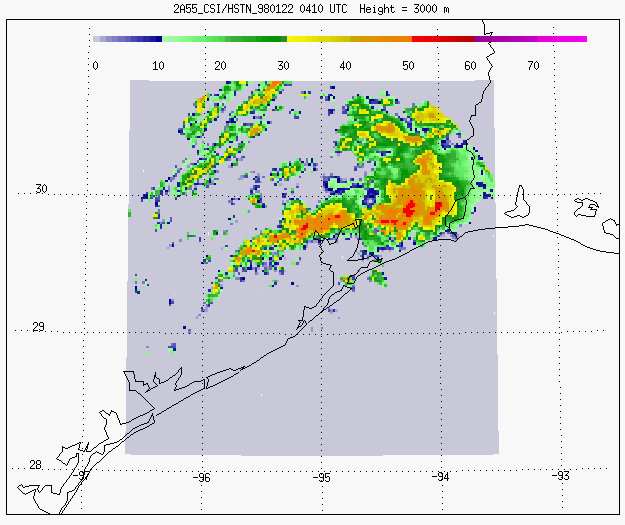
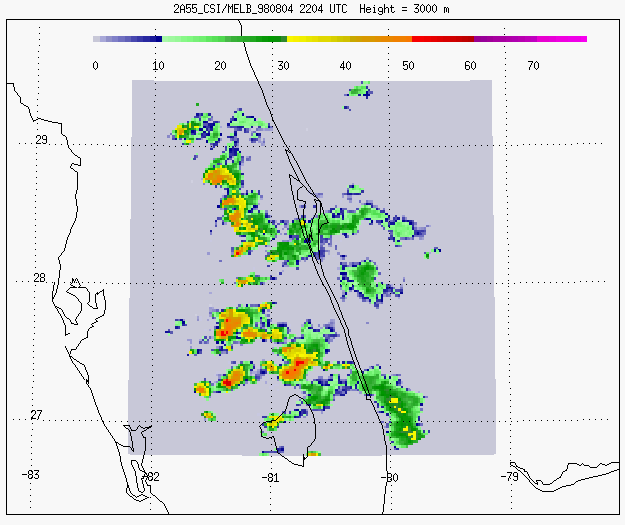
- TM stands for "Threshold Method." It is a method whereby an area
average is obtained from the fraction of the area that exceeds a fixd
threshold. The method has been studied in connection with the
Tropical Rainfall Measuring Mission (TRMM). For example,
it is possible to obtain the area average in dBZ of the following
WSR-88D ground based precipitation radar snapshots (Houston, TX,
01-22-1998, Melbourne, FL, 08-04-1998) from
the percent of the dark red area relative to the whole area.
See 1. Kedem, Chiu, Karni, J. Appl. Meteor., Vol. 29, 3-20, 1990.
2. Kedem and Pavlopoulos, J. Amer. Statist. Assoc.,
Vol. 86, 626-633, 1991. 3. Short, Shimizu, Kedem,
J. Appl. Meteor., Vol. 32, 182-192, 1993. These papers show
optimal thresholds exist under some conditions.
Houston, TX, 01-22-1998
 |
Melbourne, FL, 08-04-1998
 |
Thanks are due to Dave Wolff for the snapshot.
- PL
- PL, "partial likelihood", is an idea, due to D.R. Cox, 1975, useful
in estimation. Although
not a full likelihood, PL enjoys many of the properties of full likelihood
but at some efficiency cost. It is a notion particularly useful in
time series analysis. See 1. Slud and Kedem, Statistica Sinica,
Vol. 4, 89-106, 1994. 2.
Fokianos and Kedem, J. Mult. Analysis, Vol. 67,
277-296, 1998. PL was also used in a switching model than can be
downloaded by clicking
switching model.
See
SCMA 2005 lecture.
- Spatial Prediction (BTG)
- BTG, Bayesian-Transformed-Gaussian, is a method for spatial
prediction/interpolation formulated by
Victor De Oliveira.
See De Oliveira, Kedem, Short, J.
Amer. Statist. Assoc., Vol. 92, 1422-1433, 1997.
You can download the software (developed by David Bindel) and
learn more about
the method by clicking
BTG or
UNLV 2008 lecture.
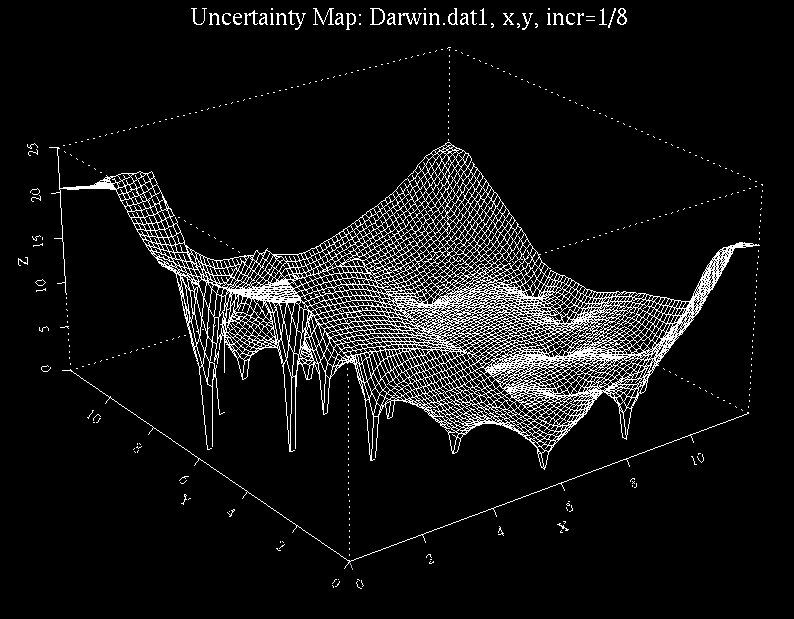
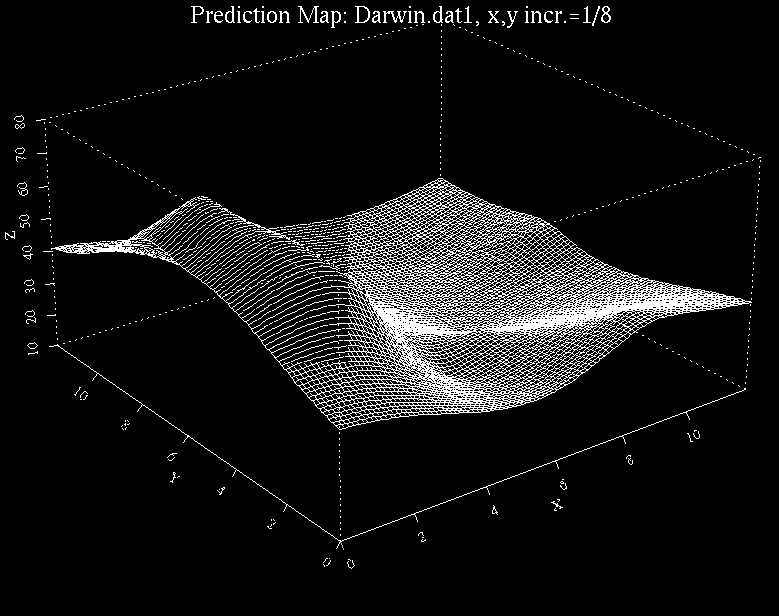
The following is an example of a prediction map obtained by BTG from 24
data points.
- Combination of Information
-
Consider m distributions where the first m-1
are obtained by multiplicative
exponential distortions of the
the mth distribution, it being a reference.
Given m corresponding samples, the semiparametric
large sample problem is worked out regarding the estimation
from the combined data of each
distortion and the common factor, and testing the hypothesis the
distributions are identical. The approach is a generalization
of the classical one way layout classification in the general sense it
obviates the need for a
complete specified parametric model. An advantage is that the common
factor, the probability density of the m'th distribution, is
estimated from the combined data and not just from the m'th sample.
A power comparison with the t and F tests obtained by simulation points
to the merit of the present approach.
The method is applied to rain rate data
from meteorological instruments. See Fokianos, Kedem, Qin,
Short,
"A semiparametric approach to the one way layout,"
Technometrics, 2001, Vol. 43, 56-65.
For an earlier work see Fokianos, Kedem, Qin,
Haferman, Short, J. Appl. Meteor. Vol. 37, 220-226, 1998.
See SLD1,
SLD2,
SLD3.
- Clipped Gaussian Random Fields
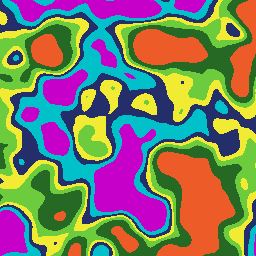
- Clipped Gaussian random fields can be used for modeling discrete-valued
random fields with a given correlation structure. If every
quantization level is represented by a specific color, then clipping
at several levels produces a color map as created by
Boris Kozintsev, 1999. Note that in "cgi?3" there are 3 colors, in
"cgi?9" there are 9 colors, etc. For more information about the online
generation of Gaussian random fields and their clipped versions click
here.
Time Series Regression Models
The GLM methodology has been extended to time series in
"Regression Models for Time Series Analysis",
by Kedem and Fokianos, Wiley, 2002.
 |
A stochastic color map representing a
scaled clipped (6 levels) version of the 256 by 256 realization on the left.
Every category is represented by a color. The 7 colors are magenta,
cyan, dark blue, yellow, light green, forest green, and orange.
For more information about the online generation of similar images,
click on any of them.
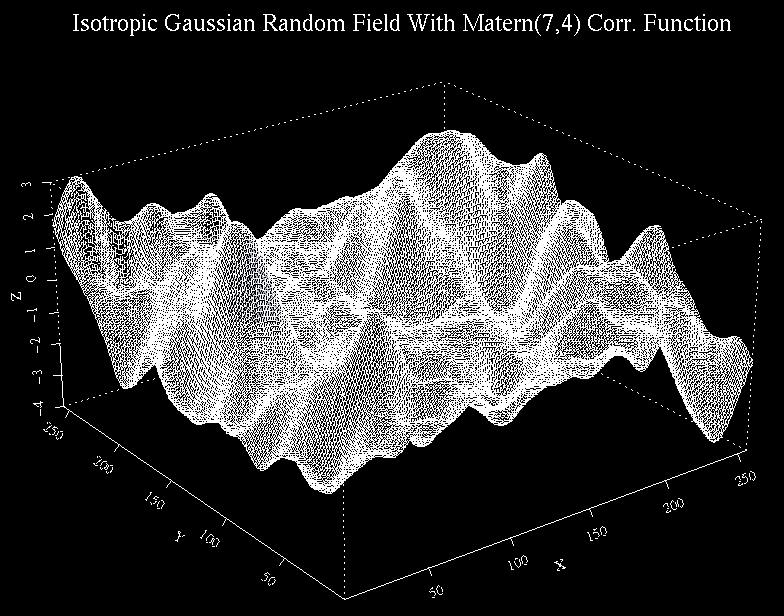
Estimation of correlation parameters in the original Gaussian random field
from clipped images is treated in
Kozintsev (1999).
|
Some 256 by 256 clipped binary images from an isotropic Gaussian random field
with Matern(1,7) correlation,
PhD Dissertations Directed
|
|
Student
|
Thesis title
|
Year
|
|
|
George Reed
|
Applications of Higher Order Crossings
|
1983
|
|
|
Donald E.K. Martin
|
Estimation of the Minimal Period of Periodically Correlated Sequences
|
1990
|
|
|
Silvia R.C. Lopes
|
Spectral Analysis in Frequency Modulated Models
|
1991
|
|
|
Haralabos Pavlopoulos
|
Statistical Inference for Optimal Thresholds
|
1991
|
|
|
James Troendle
|
An Iterative Filtering Method of Frequency Detection in a Mixed
Spectrum Model
|
1991
|
|
|
Ta-Hsin Li
|
Estimation of Multiple Sinusoids by Parametric Filtering
|
1992
|
|
|
John Barnett
|
Zero-Crossing Rates of Some Non-Gaussian Processes with Application to
Detection and Estimation
|
1996
|
|
|
Konstantinos Fokianos
|
Categorical Time Series: Prediction and Control
|
1996
|
|
|
Victor De Oliveira
|
Prediction in Some Classes of Non-Gaussian Random Fields
|
1997
|
|
|
Neal Jeffries
|
Logistic Mixtures of Generalized Linear Model Times Series
|
1998
|
|
|
Boris Kozintsev
|
Computations With Gaussian Random Fields
|
1999
|
|
|
Richard Gagnon
|
Certain Computational Aspects of Power Efficiency and of State Space Models
|
2005
|
|
|
Haiming Guo
|
Generalized Volatility Model and Calculating VaR Using a New
Semiparametric Model
|
2005
|
|
|
Guanhua Lu
|
Asymptotic Theory for Multiple-Sample Semiparametric Density
Ratio Models and its Application to Mortality Forecasting
|
2007
|
|
|
Shihua Wen
|
Semi-Parametric Cluster Detection
|
2007
|
Teaching: Spring 2006
STAT 730: Time Series Analysis
MWF 2:00 PM
Syllabus
A time series is a sequence of observations made on a stochastic
process sequentially
in ``time''. Examples are economic time series, electronic
signals (analog and digital), geophysical time series,
random binary sequences,
random vibration signals in mechanical systems, and many many more.
Time series analysis is concerned with statistical/probabilistic
methods for making inference based on sequential data; for example
forecasting or prediction and interpolation. Time series analysis
is widespread
throughout the physical and social sciences, and engineering.
Special emphasis will be placed on the use of the Splus software in
time series analysis.
A related area is the analysis of spatial data, for example,
geophysical 3D realizations. Prediction or interpolation in spatial
data is closely related to that of time series, and in fact the two
are almost indistinguishable. More generally, the correlation and
spectral theory of stationary spatial data is essentially the same as
that of time series.
In recent years there is a growing interest in regression models for
time series tailored after ordinary linear models, except that the
data are dependent, a fact that must be taken into
account. Interestingly, the fact that time series are sequential
is the basic fact that mitigates the problem of dependence under
certain regularity conditions.
For over 40 years state space models have been playing an important role in
modeling and forecasting nonstationary time series that follow
certain dynamic equations. The use of state space models is widespread
in such diverse fields as aerospace engineering and economics.
State space models may be viewed as regression models with
random coefficients.
A typical time series displays up and down oscillation. The
study of this oscillation can be approached in several ways. In
stationary time series this can be accomplished via spectral analysis,
and higher order crossings. The expected number of level crossings
by a stationary time series is an important problem in
structural engineering.
The course will cover current topics in time series analysis
including:
- 1. Splus software for time series analysis.
- 2. Spectral representation and spectral analysis of stationary
time series.
- 3. Filtering and its effect on the spectrum.
- 4. Autoregressive/moving average time series.
- 5. The AIC criterion for model adequacy.
- 6. Box-Jenkins methodology for model building and forecasting.
- 7. State space models and Kalman filtering.
- 8. Regression methods for time series.
- 9. Statistical estimation applied to time series models and
functions.
- 10. Spatial prediction/interpolation.
- 11. Higher order crossings.
- 12.
Takehome Exam
Texts:
-
B. Kedem and K. Fokianos, Regression Models for Time Series
Analysis, Wiley, 2002 (Required).
-
B. Kedem, Time Series Analysis by Higher Order Crossings, IEEE Press 1994.
-
R.H. Shumway and D.S. Stoffer, Time Series Analysis and Its
Applications, Springer, 2000.
-
G.E.P. Box, G.M. Jenkins, G.C. Reinsel, Time Series Analysis,
Forecasting and Control, 3rd Edition, Prentice-Hall, 1994.
Teaching: FALL 2007
STAT 740: Linear Models I
Math Building Room 0302, MWF 11:00 AM
Syllabus
Linear Models I deals with regression models, linear and non-linear,
satisfying various assumptions. The basic idea is to relate a dependent variable
to a set of covariates.
The course will emphasize the following topics.
- 1. SAS and Splus software for linear models, ANOVA.
- 2. The geometry of least squares; Gauss-Markov theorem.
- 3. The general linear hypothesis under normality.
- 4. One and higher-way layouts.
- 5. Analysis of covariance.
- 6. Generalized linear models.
- 7. Random effects models.
- 8. Mixed effects models.
- 9. A new approach to ANOVA based on ``tilting.''
- 10.
Regression project
-
Henry Scheffe, The Analysis of Variance, Wiley, 1999,
0-471-34-5059 (optional).
-
Alvin C. Rencher, Linear Models in Statistics, Wiley, 1999
1-31564-8 (required).
-
B. Kedem and K. Fokianos, Regression Models for Time Series
Analysis, Wiley, 2002 0-471-36355-3 (optional).
STAT 741: Linear Models II
Math Building Room 1313, MWF 10:00 AM
TakeHome Exam, Spring 2007
Service: Spring 1999
- EEEO Officer, 1998/9.
- Math/Stat Majors Committee.
- Organizer of the
Statistics
Seminar.
- Organizer of the Stat Workshop: Statistical DNA Sequence
Analysis, Tu. 3:30 PM, Rm 1313, Math Building.
Service: Spring 2003
- Director, Mathematical Statistics Program
- CBCB Committee.
Information
|
ISR Reports |
UMD - System |
UMD - College Park |
Department Directory |
Colloquium |
|
Useful Links